Good news: your dives are booked and the turtles have been told. Now one small, honest question: when was your last dive? And how many have you done in total?
Your certification card never expires. Your skills, on the other hand, quietly do. That’s not a criticism, it’s just how bodies and memories work. So before you jump off our boat, let’s work out together whether you need a Scuba Skills Update, or whether ten minutes with this page will do.
How long has it been?
Every diver is different, but here is how we see it at the dive centre:
- Just certified, a handful of dives, last dive less than 6 months ago: you’re probably fine. Read the refresh below.
- Just certified, a handful of dives, 6 to 12 months ago: there’s a good chance you won’t feel completely at ease. We’ll ask you directly when you book or arrive, and answer the eight questions below honestly.
- Just certified, a handful of dives, more than 12 months ago: a Scuba Skills Update is a must. No debate, no exception.
- Around 10 dives or more, 12 to 24 months ago: the question is open, and we strongly recommend the update.
- 20 dives or more, a little while ago: ask yourself the eight questions below. You know the answer better than anyone.
- Very experienced divers (50, 60 dives and more): even after a few years off, it usually comes back very quickly. You’ll know yourself if you’d like a refresher.
Eight honest questions
Forget “will I survive?”. Of course you will. The real questions are these:
- Will I breathe through my air like a beginner and end the dive early?
- Will I struggle to stay stable, bouncing between the sand and the surface?
- Will I feel calm and safe the whole dive, or tense from start to finish?
- Could I clear my mask right now, without thinking twice?
- Can I really control my buoyancy, hovering over the coral without touching it?
- Can I set up my own equipment without looking at what the others are doing?
- Do I know exactly how much lead I need? Not “about six kilos, I think”: the right weight for this wetsuit, this tank, salt water. If you don’t, that’s already a sign.
- If my buddy runs out of air right in front of me, do I know exactly what to do, calmly, without thinking twice?
If you answered “hmm, not so sure” to even one of them, do the update. You can only win: half a day in the pool and on a calm reef, and you’ll enjoy your stay and every dive that follows so much more.
It’s not just about you
Here is the part nobody likes to hear. On a fun dive, you’re not alone: you’re one of a group of four or five divers with a guide. The others did their update, or have been diving recently, and they’re at ease.
If you arrive rusty, you’re the one who slows down the descent because your ears won’t clear. The one who empties a tank in thirty-five minutes and brings the whole group up early. The one the guide has to watch instead of showing everyone the frogfish. Three or four people get a shorter, less relaxed dive, and they paid for theirs too.
And in an emergency, a diver who isn’t at ease with the critical skills (sharing air, clearing a mask, controlling an ascent) is a risk for themselves and for their buddy.
So be honest with yourself, and fair to the rest of the group. Skipping the pool to save half a day and a few euros isn’t worth it, not for you and not for the people diving next to you. Nobody will ever judge you for taking a Scuba Skills Update. Plenty of very good divers do one after a long break, and that’s exactly why they’re very good divers.
Not sure which group you’re in? Tell us your number of dives and the date of your last one when you book, and we’ll advise you honestly. If you need it, book a Scuba Skills Update: a relaxed theory review, a pool session to get the skills back under your fingers, then a supervised reef dive.
Good to go? The 10-minute refresh
Even if you’re fine, it’s worth dusting off the basics before you arrive.
The hand signals you’ll actually use
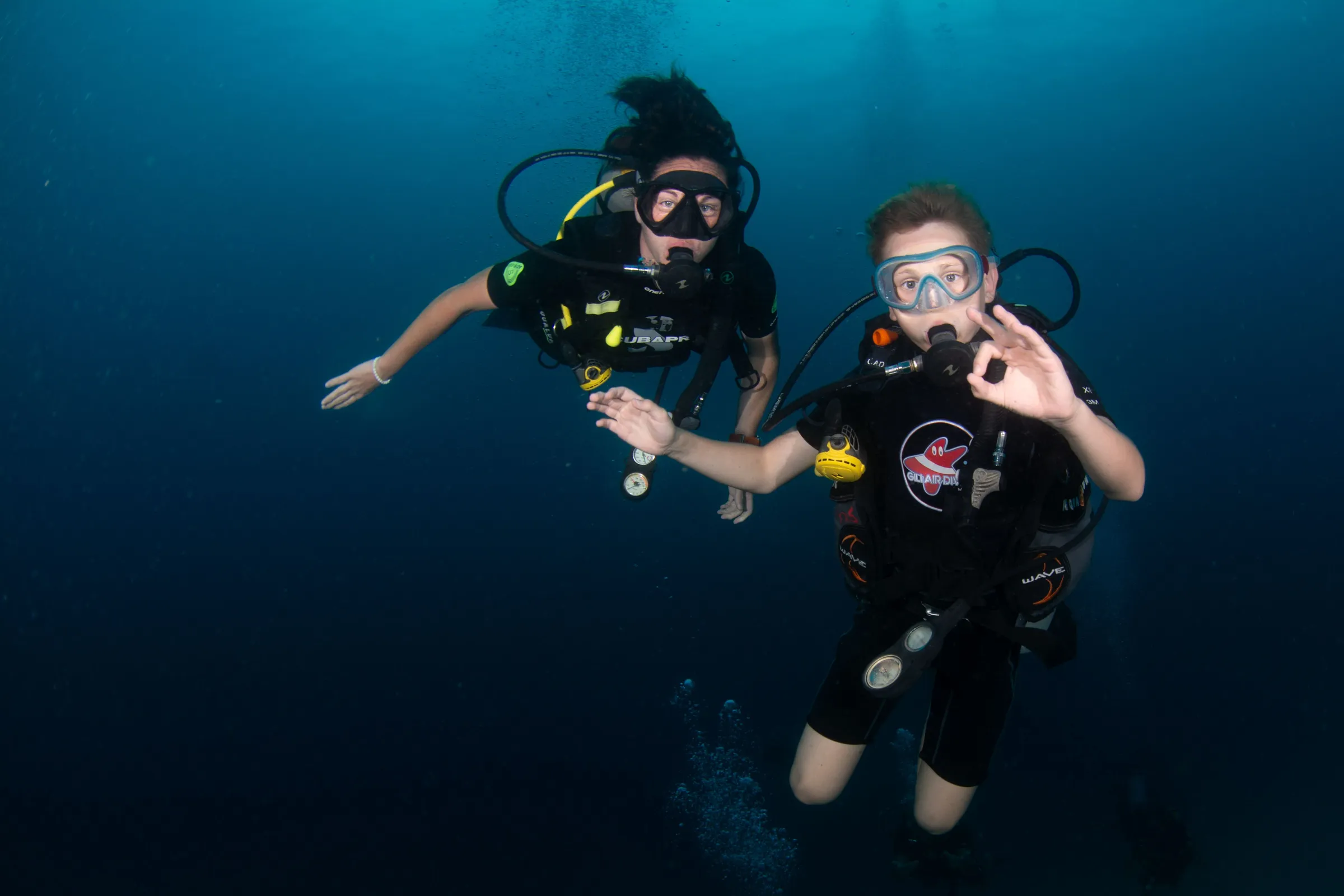
- OK: thumb and index finger in a circle, other fingers up. It’s a question and an answer. At the surface, a hand on top of your head means the same.
- Something’s wrong: flat hand, rocking side to side, then point to what’s wrong (your ear, your mask…).
- Go up: thumb pointing up. Careful: underwater, a thumbs-up does not mean “great!”, it means “let’s end the dive and ascend”.
- Go down: thumb pointing down.
- Stop / hold on: flat hand, palm facing your buddy.
- Low on air: fist against your chest.
- Out of air: flat hand slicing across your throat. Your buddy gives you their alternate air source.
- Buddy / stay together: two index fingers side by side.
Want to see them? The diving magazine Divernet has an illustrated guide with photos and a video, and the full SSI set is in the MySSI app. Your guide will go through their signals at the briefing too, and yes, there’s one for turtle.
The safety rules that never change
- Plan the dive, dive the plan. Listen to the briefing: maximum depth, maximum time, the route, what to do if you lose your buddy.
- Stay with your buddy, within reach, all dive long. Lost each other? Look around for one minute, then ascend slowly and meet at the surface.
- Do the buddy check before you jump in, five steps, every dive:
- BCD: inflates and deflates, inflator connected.
- Weights: on, secure, the right amount.
- Releases: every buckle and clip closed, and you both know how to open them.
- Air: tank open, a few breaths from each regulator, check the gauge doesn’t drop.
- Final OK: mask, fins, computer, torch if needed. Everything on you, nothing left on the bench.
- Watch your air. Check your gauge often and tell your guide when you reach the pressure given in the briefing.
- Ascend slowly: no faster than your smallest bubbles, at most 9 metres per minute (SSI’s rule), or slower if your computer says so. Never hold your breath on the way up. Diving with an instructor or a divemaster? Never go up faster than them: let them lead. It’s the one race where the last one wins.
- Always make a safety stop: 3 minutes at 5 metres.
- Flying after diving: at least 18 hours between your last dive and your flight. Details on our flying after diving page.
Equalising and buoyancy
- Equalise early and often: start at the surface, then every metre or so, before you feel pressure. Never force it. If it won’t clear, stop, signal, go up a little and try again.
- Tell us your last setup: wetsuit, weights, fresh or salt water. Bring your logbook if you have one.
- The surface check: deflated BCD, regulator in, normal breath held, and you should float with the water at eye level. Breathe out, and you slowly sink.
- Fine-tune with your lungs: breathe in and you rise a little, breathe out and you sink a little. Small puffs of air in the BCD for the big changes, your breathing for the small ones.
See you on the boat. Bring your certification card (or the digital one in the MySSI app), your logbook, and your honest answers.
Keep reading
How much does diving on Gili Air cost?
Is freediving for me? An honest answer

Freediving in Indonesia: where to go, and for whom
Women and dive computers: what science says, and five months underwater with Ksenia
Night diving on Gili Air: the reef after dark
Diving Gili Air month by month
Planning your Gili Air dive trip

When is the best time to freedive on Gili Air?
Freediving on Gili Air: the complete guide